


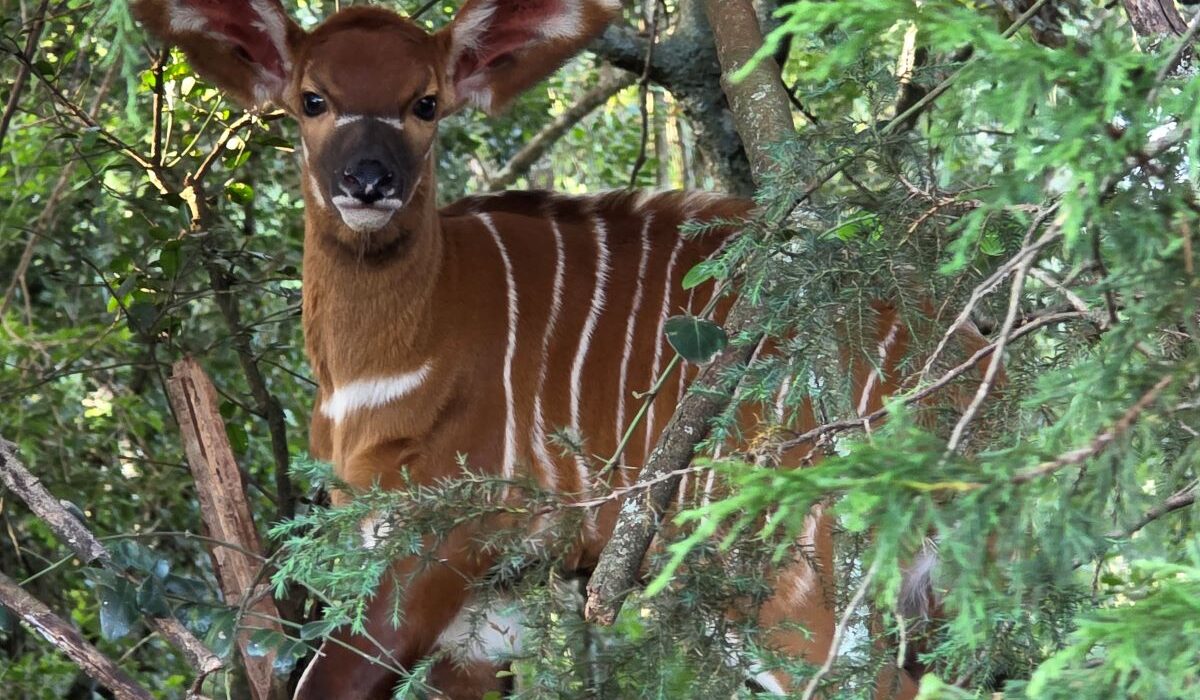
Mount Kenya Wildlife Conservancy (MKWC) has announced the birth of the 100th Mountain Bongo calf under its long-running breeding and rewilding programme, a landmark achievement that conservation experts say represents a significant step forward in efforts to save one of Kenya’s most endangered species.
The Mountain Bongo, a large forest antelope distinguished by its chestnut coat and long, spiralled horns, is listed as Critically Endangered, with only a small population remaining in the wild. The latest birth, confirmed this week, signals renewed hope for the survival of a species that was once widespread across the Mount Kenya ecosystem but was pushed to the brink of extinction by decades of habitat loss and poaching.
MKWC said the milestone reflects more than two decades of sustained conservation work focused on breeding, habitat restoration and eventual reintroduction of the species into its natural ranges.
“This landmark birth marks a major turning point in the recovery of Kenya’s native and critically endangered Mountain Bongo,” the Conservancy said in a statement, noting that the programme has now produced 100 calves since its inception.
Strong backing from wildlife authorities
Kenya Wildlife Service (KWS) Director General Prof. Erustus Kanga described the achievement as a testament to long-term commitment and collaboration between public and private conservation actors.
“The work undertaken by Mount Kenya Wildlife Conservancy is highly commendable and represents a significant step forward for wildlife conservation in Kenya,” Prof. Kanga said. “The birth of the 100th Mountain Bongo reflects more than 20 years of dedication by conservation teams, researchers, veterinarians and wildlife managers whose efforts in research, monitoring and breeding have been critical to the recovery of this critically endangered species.”
He added that KWS remains committed to working closely with the Conservancy on the Mountain Bongo breeding and rewilding programme and broader species recovery initiatives across the country. Prof. Kanga also acknowledged the role of private sector leadership in sustaining conservation financing.
“I also wish to acknowledge Humphrey Kariuki for his continued leadership and investment in this important conservation initiative,” he said.
From near extinction to cautious recovery
The Mountain Bongo was once commonly found in Kenya’s highland forests, including Mount Kenya, the Aberdares and Eburu ranges. However, encroachment on forest habitats, illegal hunting and human-wildlife conflict led to a sharp decline in numbers, leaving the species functionally extinct in much of its former range.
In response to the crisis, MKWC, in partnership with KWS, launched the Mountain Bongo Breeding and Rewilding Programme in 2004. The programme began with the repatriation of 18 Mountain Bongos from zoological institutions in the United States to Nanyuki, forming the founding population for Kenya’s recovery effort.
These animals became the genetic base for a carefully managed breeding programme aimed at building a healthy and viable population capable of surviving in the wild.
Since then, the Conservancy has steadily expanded its facilities, veterinary capacity and scientific monitoring, laying the groundwork for long-term species recovery.
A dedicated sanctuary for rewilding
A major boost to the programme came in 2022 with the opening of the Mawingu Mountain Bongo Sanctuary, described as the world’s first dedicated wild sanctuary for the species. Located within the Mount Kenya ecosystem, the sanctuary provides a secure, natural environment where Bongos can undergo a gradual rewilding process.
The sanctuary is designed to prepare the animals for eventual reintroduction into their historic habitats, including Mount Kenya, Eburu and the Aberdares, by exposing them to natural forest conditions while maintaining protection from predators and human disturbance.
Conservationists say this step is critical to ensuring that reintroduced animals are capable of surviving without intensive human support.
Leadership and long-term vision
Humphrey Kariuki, Patron of Mount Kenya Wildlife Conservancy and IUCN Patron of Nature, said the 100th birth reflects decades of coordinated effort across multiple fronts.
“This milestone reflects decades of coordinated breeding, habitat restoration and community engagement that have been critical to stabilising the species,” Mr Kariuki said. “At MKWC, we look forward to continuing this journey, expanding our research and efforts to reintroduce a healthy, self-sustaining population into the wild, and ensuring that the Mountain Bongo is no longer endangered.”
He added that protecting the species is part of a broader commitment to safeguarding Kenya’s biodiversity and natural heritage.
“Protecting this iconic species is our dedicated commitment to preserve a vital part of the country’s natural heritage for future generations,” he said.
Balancing celebration with urgency
Dr Robert Aruho, Head of Conservancy at MKWC, cautioned that while the milestone is cause for celebration, it also underscores the scale of work that still lies ahead.
“Reaching this milestone is both a celebration and a challenge,” Dr Aruho said. “It provides both the momentum and the confidence to continue our work to ensure the survival of this species.”
He noted that restoring wildlife populations requires sustained investment, scientific rigour and strong partnerships, particularly as climate change and human pressure continue to threaten forest ecosystems.
“This achievement reflects years of dedication, collaboration and commitment to restoring wildlife populations and preserving Mount Kenya’s unique biodiversity,” he said.
Conservation linked to communities and education
Beyond species recovery, MKWC operates an integrated conservation model that links wildlife protection with community empowerment and education. Under the patronage of Mr Kariuki, the Conservancy has invested in programmes that engage surrounding communities as key stakeholders in conservation success.
Through rescue and rehabilitation centre visits, habitat restoration initiatives and adoption programmes, individuals and organisations are able to contribute directly to conservation outcomes.
Education is a central pillar of the model. More than 30,000 students participate in MKWC’s education and empowerment programmes each year, gaining exposure to biodiversity conservation, sustainable natural resource management and environmental stewardship.
Conservation experts say such community-centred approaches are essential for long-term success, particularly in landscapes where human livelihoods and wildlife habitats intersect.
Partnerships and private sector support
The Mountain Bongo recovery effort has been underpinned by a wide network of partnerships. MKWC works closely with Kenya Wildlife Service and Kenya Forest Service, as well as international conservation organisations including Chester Zoo, the European Association of Zoos and Aquaria (EAZA) and the International Union for Conservation of Nature (IUCN).
The Conservancy also acknowledged support from corporate partners such as Janus Continental Group, Dalbit Petroleum, Kenya Pipeline Company and I&M Bank, alongside individual donors and foundations.
Such partnerships highlight the growing role of private capital and corporate social investment in supporting conservation outcomes that have both ecological and socio-economic value.
Looking ahead
With 100 Mountain Bongos now bred under the programme, MKWC says its focus is firmly on building a self-sustaining wild population that can thrive without intensive human intervention.
For Kenya, the milestone represents more than a conservation success story. It signals the potential for well-coordinated, long-term investment to reverse biodiversity loss, protect natural capital and strengthen the country’s position as a global leader in wildlife conservation.