


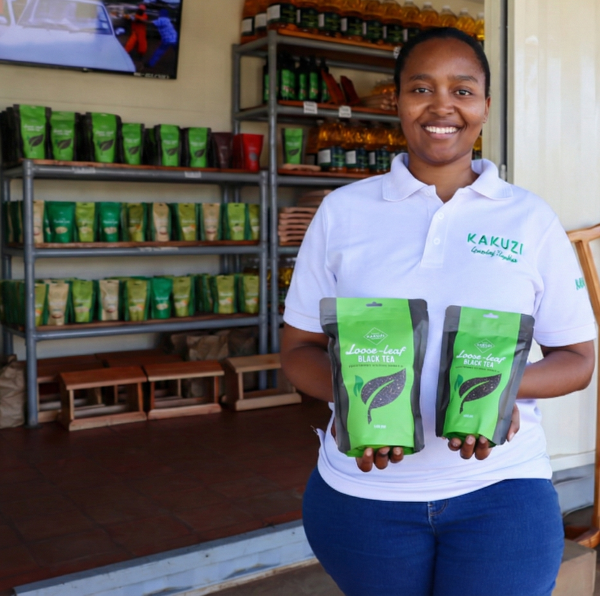
Listed agribusiness firm Kakuzi Plc has entered Kenya’s domestic tea retail market with the launch of Kakuzi Pure Black Tea, as it accelerates a diversification strategy aimed at boosting earnings and reducing reliance on export markets.
Listed agribusiness firm Kakuzi Plc has expanded its domestic consumer offerings with the introduction of a new loose-leaf tea product, marking the company’s first entry into Kenya’s local tea retail segment as part of a broader strategy to diversify revenues and strengthen earnings resilience.
The firm has launched Kakuzi Pure Black Tea, a quality loose-leaf tea brand available in 250-gram and 500-gram consumer packs. The product is sourced from Kakuzi’s Kaboswa Tea Estate in Nandi County and targets Kenyan consumers seeking premium, export-grade tea for local consumption.
Kakuzi Managing Director Chris Flowers said the launch reflects the company’s ongoing focus on developing high-quality, value-added consumer products for the domestic market, alongside its established export-oriented agribusiness operations.
“This is the first time in our history that we are delivering a quality tea brand for the local market, sourced from our Kaboswa Tea Estate in Nandi County,” Flowers said. “Kenyans will enjoy quality export-grade Kakuzi tea leaves in convenient consumer packs.”
Diversifying beyond exports
The introduction of Kakuzi Pure Black Tea forms part of a wider products-and-markets diversification strategy that the company says is already beginning to deliver results. According to Kakuzi, domestic sales of its consumer products are recording steady growth and are increasingly contributing positively to the group’s balance sheet.
Historically, Kakuzi’s earnings have been anchored in export crops, particularly avocados and macadamia nuts, which remain its flagship products. However, management has been steadily broadening the business model to include local value-added products, reducing exposure to external market shocks and fluctuating international commodity prices.
By packaging and selling locally processed and blended tea for domestic consumption, the firm aims to mitigate risks associated with reliance on export markets at a time when global tea trade conditions have become more volatile.
“By focusing on local value addition and domestic sales, we are deliberately working to reduce export-only risk, particularly as international tea trade fortunes continue to face pressure,” Flowers said.
Leveraging Kenya’s tea heritage
Kenya is one of the world’s leading tea producers and exporters, yet the majority of its tea has traditionally been sold in bulk for blending and branding overseas. Kakuzi’s move into branded local tea retail aligns with a growing trend among agricultural producers to capture more value within the domestic market.
Kakuzi Pure Black Tea is grown in the Nandi Hills at an altitude of nearly 2,000 metres above sea level, conditions that the company says provide an ideal combination of cool temperatures, fertile soils, and ample sunshine. According to Kakuzi, each packet contains more than 2,000 hand-picked shoots, carefully selected to deliver a rich, full-bodied flavour.
The company said all its locally sold products are benchmarked against export-grade standards, underscoring its positioning of the tea brand as a premium offering rather than a mass-market commodity.
Industry analysts note that Kenya’s urban middle class, rising consumer awareness, and expanding modern retail channels are creating opportunities for locally branded premium food and beverage products, including tea.
Building a domestic consumer brand portfolio
The tea launch adds to a growing list of Kakuzi products targeted at Kenyan consumers. In recent years, the company has rolled out several value-added offerings, including ready-to-eat macadamia nuts, cold-pressed macadamia oil, and blueberry products.
These products are available through selected retail outlets, the Kakuzi Farmers Market along the Nairobi-Nyeri Highway, and via the company’s online store. The strategy reflects a deliberate shift toward closer engagement with end consumers, complementing Kakuzi’s long-established role as a bulk agricultural producer.
At its Makuyu operations in Murang’a County, Kakuzi runs an integrated macadamia processing facility with an installed capacity of 2,000 tonnes of saleable kernel, making it one of the largest macadamia processing plants in Kenya. The company also operates a macadamia oil extraction plant with a cold-pressed capacity of up to 1,000 litres per day.
Management says these processing capabilities provide a strong foundation for scaling value-added consumer products while retaining control over quality and traceability.
Long-term growth plans
Beyond consumer product expansion, Kakuzi has outlined ambitious long-term growth targets across its core agricultural segments. Last year, the company disclosed plans to nearly double avocado production and exports over the next decade, increasing volumes from 3 million to 5 million four-kilogram equivalent cartons.
Kakuzi is also targeting significant growth in macadamia output, with plans to raise production from 900 tonnes of kernel to 1,500 tonnes. These investments are aimed at strengthening the firm’s export earnings while domestic sales provide an additional buffer against market volatility.
The company says its diversification strategy is firmly anchored in supporting local production, promoting Kenyan-grown products, and contributing to value addition within the country’s agricultural sector.
Implications for the agribusiness sector
Kakuzi’s entry into the domestic tea retail market is expected to intensify competition in Kenya’s premium tea segment, traditionally dominated by a small number of established brands. It also signals a broader shift among large agricultural producers toward local branding, processing, and direct-to-consumer sales.
For investors, the move highlights efforts by listed agribusiness firms to stabilise earnings by balancing export exposure with domestic revenue streams. As global agricultural markets remain vulnerable to climate risks, logistics disruptions, and price volatility, diversification into local value-added products is increasingly seen as a strategic necessity.
With Kakuzi Pure Black Tea now on the shelves, the company is positioning itself not just as a major exporter, but as a growing player in Kenya’s consumer food and beverage market.