


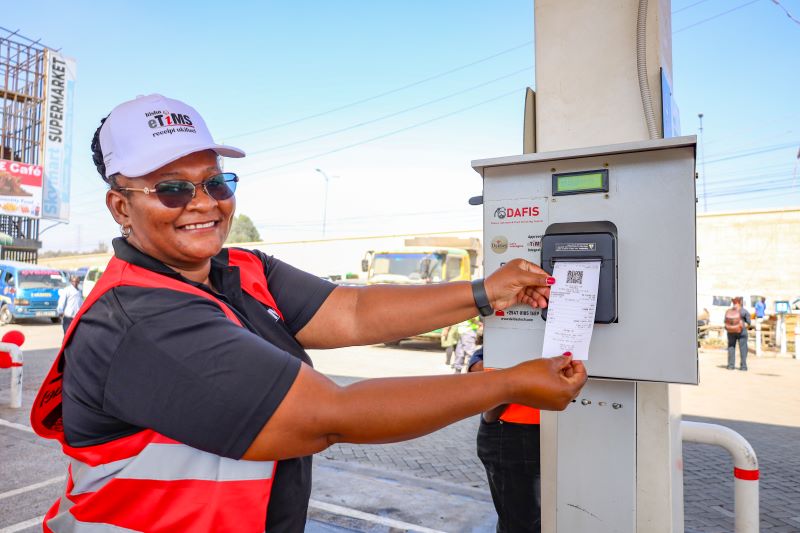
The Kenya Revenue Authority (KRA) has onboarded more than 500 fuel stations onto its Electronic Tax Invoice Management System (eTIMS) fuel module following its full rollout in December 2025, marking a major step in digitising tax compliance within the petroleum sector.
The onboarded outlets represent approximately 16 percent of fuel stations nationwide, as the tax authority moves to enhance transparency and strengthen revenue mobilisation across the fuel value chain.
KRA says the eTIMS fuel module is designed to provide end-to-end visibility of petroleum transactions, from importation and storage to distribution and final retail sale. The system integrates fuel volume data with tax declarations, enabling automatic reconciliation of physical product flows against declared sales and corresponding tax liabilities.
Speaking during an engagement at Be Energy Ruai, KRA Acting Deputy Commissioner for the Large Taxpayers’ Office, Ezekiel Obura, said the authority expects revenue collection within the sector to grow by double digits once full implementation is achieved.
“The system integrates seamlessly with import records and the VAT administration framework, enabling automatic reconciliation of physical fuel volumes against declared sales volumes and corresponding tax positions,” Mr Obura said.
He urged consumers to request eTIMS receipts after every fuel purchase, noting that public participation is critical to ensuring compliance at the retail level. Mr Obura also encouraged fuel stations yet to onboard to comply, adding that KRA is ready to facilitate integration and provide engagement support ahead of enforcement measures.
Centralised Oversight of Oil Marketing Companies
KRA confirmed that all Oil Marketing Companies (OMCs) have now been domiciled under the Large Taxpayers’ Office to enable closer monitoring, faster issue resolution and tailored compliance support.
The authority implemented the eTIMS fuel solution in collaboration with sector regulators and industry bodies, including the Energy and Petroleum Regulatory Authority, Petroleum Institute of East Africa, Petroleum Outlets Association of Kenya and United Energy & Petroleum Association.
KRA officials said this multi-agency approach was intended to ensure the system reflects operational realities across the sector while aligning with regulatory and pricing frameworks.
Fuel is a controlled commodity in Kenya, with prices regulated monthly by the Energy and Petroleum Regulatory Authority. As such, authorities can benchmark expected revenue flows against regulated pricing structures and declared import volumes.
Digital Strategy and VAT Compliance
KRA Chief Manager for the eTIMS Office, Hakamba Wangwe, said the fuel module forms part of a broader strategy to simplify tax compliance through digital systems and enhance oversight.
“The eTIMS Fuel Stations Module is a game changer for tax compliance and transparency. It simplifies the tax process for taxpayers and enhances oversight for the Authority, supporting Kenya’s broader goal of a fully digital, efficient and accountable tax system,” Ms Wangwe said.
She noted that the module leverages integrated data streams, including import records and pricing benchmarks from EPRA, to assess expected revenues across the petroleum value chain. The enhanced data visibility allows the authority to track fuel movements from importation and storage to transfers between operators and eventual retail sales at service stations.
According to KRA, the digital integration is expected to minimise revenue leakage, improve reporting accuracy and ensure equity among market players by reducing opportunities for under-declaration of sales.
The initiative also strengthens enforcement of the Value Added Tax (Electronic Tax Invoice) Regulations, 2020, which require VAT-registered businesses to issue electronic tax invoices for eligible transactions.
Industry Response and Operational Impact
Industry players have begun adjusting operations to accommodate the new digital reporting requirements.
Speaking on behalf of Be Energy Ruai, Josephine Warui said the system has streamlined customer service operations at the retail level.
“Sales summaries are now automatically generated and receipts seamlessly discharged within the system, significantly reducing customer service time. Our reports are quite easy and we use less time to serve our customers, you fuel and your receipt is instant,” Ms Warui said.
Under the system, eTIMS receipts are issued instantly at the point of sale upon request and can be generated for both individual motorists and businesses. For corporate customers, digital receipts provide improved record-keeping and easier reconciliation for input VAT claims.
Phased Rollout and Compliance Timeline
Before full implementation, KRA piloted the fuel module with volunteer fuel stations between September and December 2024. The pilot phase tested technical integration, gathered operational feedback and strengthened compliance frameworks.
Nationwide onboarding began in January 2025. Although the initial compliance deadline had been set for June 30, 2025, industry stakeholders requested additional time to meet system requirements. KRA subsequently extended the deadline to December 2025.
With over 500 stations already onboarded, the authority is expected to intensify engagement efforts to raise compliance levels beyond the current 16 percent penetration.
Revenue and Fiscal Implications
The petroleum sector remains one of Kenya’s largest contributors to tax revenue, generating income through excise duty, VAT, import levies and other statutory charges. Any leakages within the sector have significant fiscal implications.
Analysts say that full digitisation of petroleum transactions could enhance revenue predictability, reduce disputes and improve compliance efficiency. Automatic reconciliation between declared sales and physical volumes may also reduce audit cycles and administrative costs for both KRA and compliant businesses.
As Kenya continues to pursue domestic revenue mobilisation to finance budgetary obligations, digitisation of high-revenue sectors such as petroleum is expected to remain a priority.
KRA has reiterated its call for both retailers and consumers to support the transition by ensuring eTIMS receipts are issued and retained for every transaction. The authority says continued collaboration with industry stakeholders will be central to achieving full compliance and maximising the module’s intended impact.