


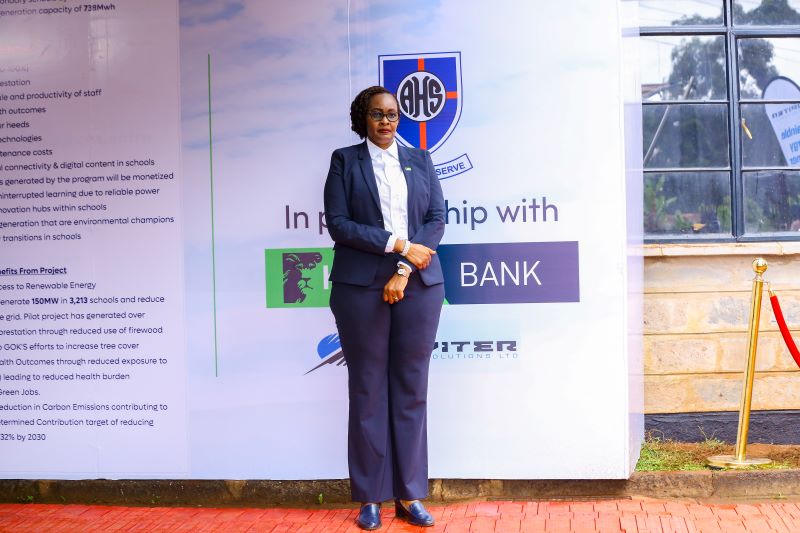
KCB Bank Kenya has reaffirmed its commitment to financing renewable energy solutions in schools, backing a solarization project at Alliance High School during the institution’s centenary celebrations attended by William Ruto.
KCB Bank Kenya has reinforced its push into clean energy financing with support for a solar power installation at Alliance High School, positioning the project as a model for sustainable infrastructure development in Kenya’s education sector.
The solarization initiative was unveiled during the school’s 100-year anniversary celebrations, an event attended by President William Ruto, underscoring the growing alignment between public policy and private sector investment in renewable energy infrastructure.
The lender said the project reflects its broader strategy to accelerate Kenya’s transition to clean energy by offering structured financing models designed to make solar and other renewable technologies more accessible to institutions.
Clean Energy As A Financing Frontier
Speaking during the centenary event, KCB Bank Kenya Managing Director Annastacia Kimtai said the bank is leveraging its financial expertise to unlock new investments in renewable energy by reducing lending risks and offering flexible financing options.
“KCB is leveraging its financial expertise to unlock new investment in the sector by de-risking lending and providing flexible financing models to ensure that solarization growth is both sustainable and inclusive, especially in learning institutions,” Kimtai said.
The installation at Alliance High School is expected to improve energy reliability, lower electricity bills and reduce the institution’s carbon footprint. Education institutions, particularly boarding schools, are among the country’s largest institutional energy consumers due to cooking, lighting and equipment demands.
By transitioning to solar and hybrid clean energy systems, schools can significantly cut operational costs, freeing up resources for academic programs and infrastructure improvements.
Expanding Solar And Clean Cooking Solutions
KCB’s clean energy financing extends beyond standard rooftop solar installations. The bank currently provides four key structured solutions tailored to institutional needs:
- Solar-powered cooking systems that also power lighting and equipment during non-cooking hours
- Steam-based cooking systems combined with solar for broader energy needs
- Liquefied Petroleum Gas (LPG) for clean cooking integrated with solar power
- Biogas systems that convert organic waste into usable energy
According to the bank, it has financed more than 250 schools with solarization and LPG facilities to date, signaling growing demand within the education sector for alternative energy solutions.
The integration of solar-powered cooking and hybrid systems addresses a critical cost driver for boarding schools, which traditionally rely on firewood, diesel or grid electricity for large-scale meal preparation.
Policy Alignment And Climate Commitments
Kenya has positioned itself as a regional leader in renewable energy, with over 80 percent of its grid electricity generated from renewable sources including geothermal, hydro and wind. However, institutional energy consumption, particularly in off-grid and semi-urban areas, remains reliant on fossil fuels and biomass.
The government has in recent years intensified efforts to promote clean cooking solutions and decentralized renewable energy systems as part of its climate mitigation strategy.
President Ruto’s presence at the Alliance High School event reflects the administration’s emphasis on climate-smart infrastructure across public institutions. The government has repeatedly signaled support for partnerships between financial institutions and learning institutions to scale renewable energy adoption.
The solarization project also contributes to Kenya’s commitments under global climate agreements to reduce greenhouse gas emissions and expand access to sustainable energy solutions.
Clean Energy Customer Value Proposition
KCB’s clean energy initiatives are anchored in its Clean Energy Customer Value Proposition (CVP), a structured financing framework designed to accelerate adoption of renewable technologies among households, small and medium enterprises, agribusinesses and institutions.
Through this model, the bank offers accessible financing, tailored advisory services and innovative funding structures aimed at lowering the upfront cost barriers that often hinder clean energy investments.
Financial institutions have increasingly identified green financing as both a commercial opportunity and a risk mitigation strategy, as climate-related risks begin to influence credit assessments and long-term portfolio performance.
By de-risking renewable energy lending and developing sector-specific financing packages, banks can support climate adaptation while expanding their lending books in emerging sectors.
Economic And Institutional Impact
Energy costs represent a significant share of operational expenditure for large public and private schools. Solarization not only stabilizes energy supply but also reduces exposure to grid disruptions and rising utility tariffs.
For Alliance High School, one of Kenya’s most prominent national schools, the installation is expected to serve as a demonstration project that could encourage similar institutions to adopt renewable energy solutions.
The shift to solar and hybrid systems also supports broader sustainability goals, including reduced reliance on firewood, which contributes to deforestation and environmental degradation.
Beyond schools, KCB’s clean energy financing portfolio spans agribusinesses seeking solar-powered irrigation, SMEs installing rooftop solar systems, and households adopting solar home systems and clean cooking solutions.
As demand for climate-smart infrastructure grows, lenders are increasingly integrating environmental risk assessments and sustainability metrics into their core lending frameworks.
Banking Sector And Green Growth
Kenya’s banking sector has in recent years moved to incorporate Environmental, Social and Governance (ESG) considerations into lending practices, partly driven by regulatory guidance from the Central Bank of Kenya and global investor expectations.
Green financing products are becoming a competitive differentiator among lenders seeking to capture emerging growth segments linked to renewable energy, sustainable agriculture and climate-resilient infrastructure.
KCB’s continued expansion into solarization and clean cooking financing aligns with this broader shift toward sustainable banking practices.
As institutions across Kenya face rising energy costs and climate-related risks, access to structured financing solutions will likely play a central role in determining the pace of renewable energy adoption.
With over 250 schools already financed under its clean energy programs, KCB is positioning itself as a key financial intermediary in Kenya’s low-carbon transition.
The Alliance High School project adds a symbolic milestone to that strategy, linking one of the country’s oldest educational institutions with modern renewable energy infrastructure as Kenya seeks to balance economic growth with environmental sustainability.