


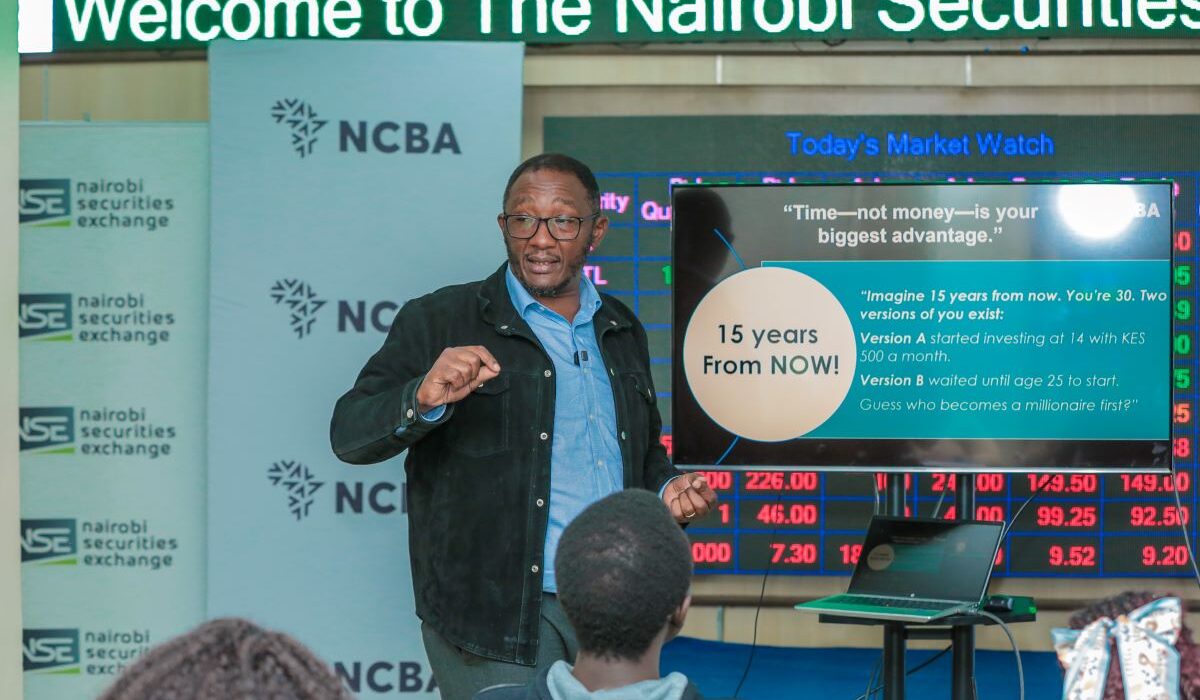
The Nairobi Securities Exchange (NSE) has intensified its push to broaden participation in Kenya’s capital markets by targeting teenagers, hosting a high-impact financial literacy and early investor empowerment workshop aimed at nurturing the next generation of investors.
The workshop, held at the NSE headquarters in Nairobi, brought together young participants aged between 12 and 17 years and was organised in collaboration with Abojani Investment and partner NCBA Investment Bank. The initiative forms part of a broader effort to instil sound financial habits early and address what market players describe as a widening generational gap in investor participation.
According to NSE-linked market data, the average age of investors actively participating in Kenya’s capital markets currently stands between 40 and 50 years, raising concerns about the long-term sustainability of the retail investor base if younger cohorts are not deliberately brought into the system.
“The average age of investors currently engaging with the Nairobi Securities Exchange is between 40 and 50 years old,” said Samuel Gichohi, Head of Business Development at NCBA Investment Bank. “This generational gap means that if younger investors are not introduced to the market early, the current system may face significant challenges in the future.”
Kenya’s capital markets have historically struggled to attract and retain retail investors, with participation often concentrated among older, urban, and higher-income groups. While mobile money and digital platforms have expanded access to financial services, translating that access into long-term investment behaviour has remained a challenge.
Organisers of the teen-focused workshop said early financial education is critical to reversing this trend, especially as young people increasingly enter adulthood without basic knowledge of budgeting, saving, or investing.
Nancy Nasimiyu of Abojani Investment said many young people approach the job market with limited understanding of personal finance, leaving them vulnerable to poor financial decisions early in life.
“Youth entering the job market are often a bit blank when it comes to money matters,” she said. “Our aim is to show younger generations the path to becoming economically secure, potentially by the age of 18, simply by understanding budgeting, saving, smart spending, and the basics of investing in the stock exchange.”
The workshop focused on practical, simplified financial concepts designed to help teenagers build healthy money habits and shift their mindset from working solely for income to building long-term investment portfolios where money works for them over time.
Participants were introduced to core financial literacy principles, starting with budgeting as the foundation for wealth creation. Trainers emphasised the importance of understanding income flows, controlling expenses, and deliberately creating disposable income that can be channelled into savings and investments.
One of the key tools taught during the session was the widely used 50/30/20 budgeting rule, where 50 per cent of income is allocated to needs, 30 per cent to wants, and 20 per cent to investment. Facilitators explained how the framework can help young people develop discipline, prioritise long-term goals, and avoid lifestyle inflation as their incomes grow.
The concept of emergency funds was also introduced, with teens encouraged to appreciate that financial journeys involve both gains and setbacks. Trainers stressed the importance of setting aside funds for unexpected events, reinforcing the idea that financial resilience is as important as wealth accumulation.
Investment fundamentals formed a central pillar of the workshop. Participants learned how individuals can earn interest by lending money to the government through instruments such as Treasury bonds, as well as how equity investors earn dividends by holding shares in companies whose products and services they already consume daily.
The sessions also addressed investment risks, including price volatility and potential losses, with facilitators emphasising the importance of long-term thinking, diversification, and emotional discipline when markets fluctuate.
A major focus of the workshop was demystifying access to the capital markets for minors. Participants were introduced to Junior Central Depository System (CDS) accounts, which allow young people to legally own shares under the custodianship of their parents or guardians.
Organisers described Junior CDS accounts as a powerful tool for early wealth building, allowing young investors to benefit from the advantage of time and compound growth long before they enter formal employment.
“Starting early gives young people something older investors cannot buy back, which is time,” said one facilitator. “Even small, consistent investments can grow significantly when compounded over many years.”
To reinforce theoretical learning, the workshop included a hands-on experience at the NSE trading floor, where participants observed live trading and gained a clearer understanding of how markets operate. The exposure helped link everyday consumption to shareholder value, showing teens how buying products from listed companies can indirectly contribute to corporate performance and investor returns.
NCBA Investment Bank used the platform to reaffirm its commitment to financial empowerment and the development of future investors. The bank highlighted its role in supporting early investment pathways and providing professional guidance for young investors and their families.
The initiative comes at a time when regulators and market institutions are under increasing pressure to deepen domestic participation in capital markets, particularly as foreign investor activity remains sensitive to global economic conditions and geopolitical risks.
By targeting teenagers, the NSE and its partners hope to build a pipeline of informed, confident retail investors who can support market liquidity, capital formation, and long-term economic growth.
Market analysts say such initiatives could play a critical role in reshaping Kenya’s investment culture, which has traditionally favoured real estate and informal savings over structured capital market products.
“Financial literacy at a young age has a multiplier effect,” said an independent investment analyst. “It not only benefits the individual but strengthens the entire financial ecosystem by creating informed investors, responsible borrowers, and disciplined savers.”
As Kenya positions itself as a regional financial hub, stakeholders argue that broad-based investor education must go hand in hand with product innovation, regulatory reform, and digital access.
The NSE-led teen financial literacy workshop signals a strategic shift toward long-term market development, recognising that the future of Kenya’s capital markets depends not only on institutional investors and policy reforms, but also on cultivating informed participation from the youngest generation.