


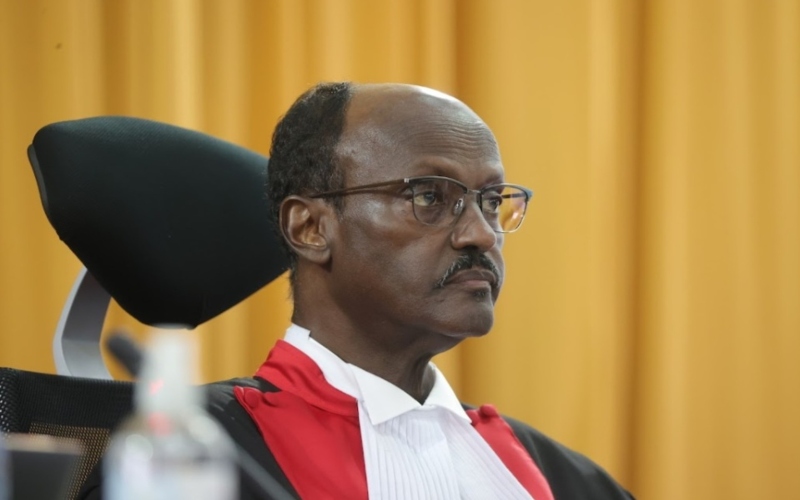
Kenya’s Judiciary is in mourning following the death of Supreme Court Judge Mohammed Kadhar Ibrahim, a long-serving jurist whose career spanned advocacy, judicial reform, and the consolidation of constitutional governance under the 2010 Constitution.
Chief Justice Martha Koome announced the passing of Justice Ibrahim on behalf of the Judiciary, the Supreme Court of Kenya, and the Judicial Service Commission (JSC), describing his death as a profound loss to the country’s justice system.
“On behalf of the Judiciary, the Supreme Court of Kenya, the Judicial Service Commission, and on my own behalf, I convey, with profound sorrow, the news of the passing of Hon. (Mr.) Justice Mohammed Kadhar Ibrahim,” said Chief Justice Koome in an official statement. “We extend our deepest condolences to his family, friends, colleagues, and the entire Judiciary and JSC during this moment of immense loss.”
Justice Ibrahim was serving as a Judge of the Supreme Court of Kenya and as a Commissioner of the Judicial Service Commission at the time of his death, roles that placed him at the heart of Kenya’s judicial governance and constitutional oversight.
Trailblazer in Kenya’s Legal Profession
Before joining the Bench, Justice Ibrahim had built a distinguished reputation as an advocate and human rights defender. Admitted to the Bar in 1982, he made history as the first member of the Kenyan Somali community to be admitted as an Advocate of the High Court of Kenya, a milestone widely viewed as a breakthrough for representation and inclusion in the legal profession.
He practised law at several prominent firms before establishing his own legal practice, focusing on public interest litigation and civic advocacy during periods of heightened political repression.
Justice Ibrahim worked closely with civil society organisations including Kituo cha Sheria and the Lawyers Committee for Human Rights and served as a founding trustee of the Mwangaza Trust. Through these roles, he championed access to justice, legal empowerment for marginalised communities, and the defence of fundamental rights at a time when civil liberties were frequently under threat.
Role in Kenya’s Pro-Democracy Struggle
During Kenya’s push for multiparty democracy in the late 1980s and early 1990s, Justice Ibrahim emerged as a key legal ally of pro-democracy activists. He provided legal representation and advisory support to political detainees, activists, and communities facing state repression.
His advocacy came at personal cost. Justice Ibrahim was detained without trial, an experience that the Judiciary says deeply shaped his lifelong commitment to constitutionalism, the rule of law, and the protection of human dignity.
He later served as a Council Member of the Law Society of Kenya, contributing to institutional reforms and ethical standards within the legal profession.
Distinguished Judicial Career
Justice Ibrahim joined the Judiciary in 2003 as a Judge of the High Court of Kenya, serving in various stations and earning a reputation for diligence, intellectual rigour, and fairness.
In 2011, he was elevated to the Supreme Court of Kenya as part of its inaugural bench following the promulgation of the 2010 Constitution. The appointment placed him among the judges tasked with interpreting and giving effect to the country’s transformative constitutional order.
According to the Judiciary, his work at the Supreme Court was characterised by calm impartiality, deep respect for constitutional values, and a consistent concern for the rights of vulnerable and marginalised groups.
Over more than a decade on the apex court, Justice Ibrahim participated in landmark decisions on electoral justice, constitutional interpretation, and the balance of power among state institutions.
Service at the Judicial Service Commission
In 2022, Justice Ibrahim was unanimously elected by his fellow Supreme Court judges to represent the Court at the Judicial Service Commission, the constitutional body responsible for judicial appointments, discipline, and administration.
At the JSC, he was described as a steady and principled voice on issues of judicial independence, accountability, and governance.
“He firmly believed that judicial independence and accountability are complementary, not competing values,” Chief Justice Koome said, noting that his contribution helped strengthen public confidence in the Judiciary during periods of intense scrutiny.
Justice Ibrahim consistently advocated for transparency, integrity, and fidelity to constitutional norms, positions that aligned with broader reforms aimed at strengthening institutional credibility and performance within the justice sector.
Leadership in Electoral Preparedness
Justice Ibrahim also played a central role in strengthening the Judiciary’s capacity to handle electoral disputes, an area critical to Kenya’s political stability.
He served as Chairperson of the Judiciary Committee on Elections and earlier chaired the ad hoc Judiciary Working Committee on Election Preparations. Through these roles, he helped enhance institutional readiness, procedural clarity, and public confidence in the adjudication of election-related cases.
Judicial colleagues described him as a collegial judge and quiet mentor who prioritised principles over personal prominence.
Tributes Highlight Legacy of Integrity
Across the legal fraternity, Justice Ibrahim is being remembered as a jurist of humility, integrity, and moral courage, whose career bridged activism and judicial service.
“The Judiciary, the Supreme Court and the JSC mourn the loss of a distinguished jurist whose legacy bridges courageous advocacy and principled judging,” the statement said.
His life and career, the Judiciary noted, exemplified fidelity to the oath of office, service to country, and compassion for the voiceless.
National Loss to the Justice System
Justice Ibrahim’s death comes at a time when Kenya’s Judiciary continues to navigate reform pressures, governance challenges, and heightened public expectations.
Analysts say his passing removes a stabilising figure whose institutional memory and commitment to constitutionalism were critical to the Supreme Court and the Judicial Service Commission.
As tributes continue to pour in, the Judiciary has called for sensitivity and compassion as the legal community and the nation mourn one of the architects of Kenya’s modern judicial order.
“May the soul of Hon. Justice Mohammed Kadhar Ibrahim rest in eternal peace,” Chief Justice Koome said.