

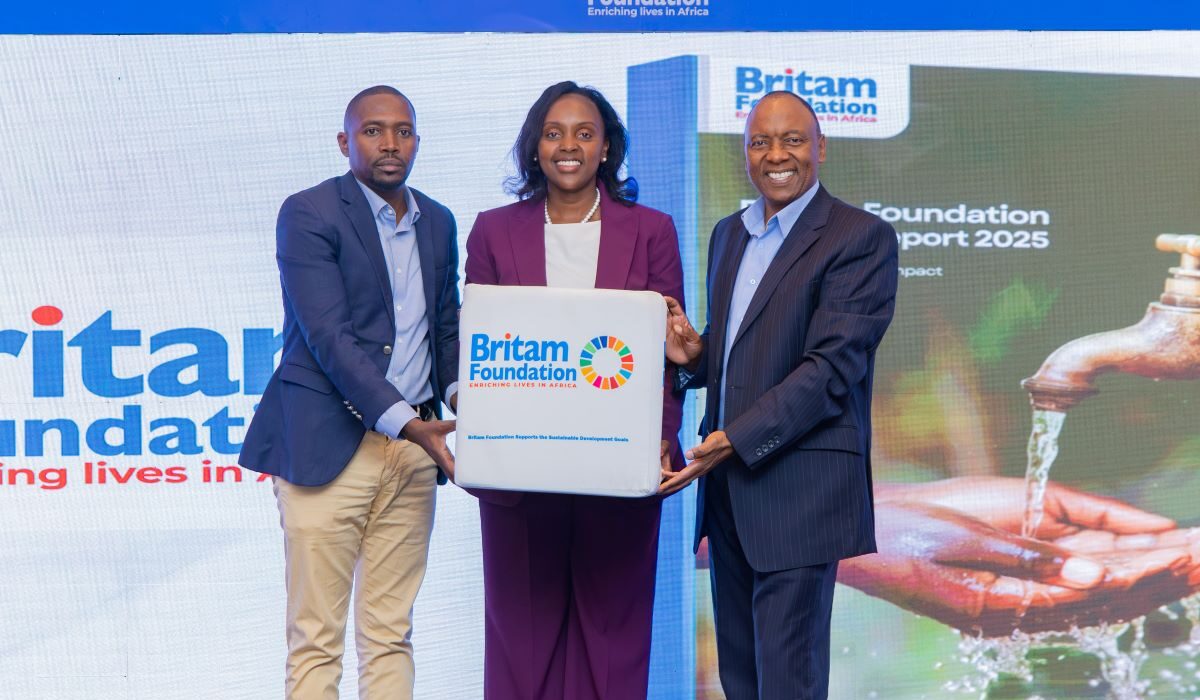
Britam Foundation has released its inaugural Impact Report, revealing how targeted investments in water access, maternal health, environmental restoration and enterprise development have improved livelihoods for more than 92,000 people and created over 1,300 jobs across East Africa since late 2024.
Britam Foundation has unveiled its first Impact Report, detailing the outcomes of its initial phase of operations and underscoring how structured corporate-backed community investment can deliver measurable social and economic returns.
According to the report, the Foundation’s programmes across water access, maternal health, environmental restoration and enterprise development have collectively empowered more than 92,000 people and created 1,358 jobs across Kenya, Uganda, Tanzania and Rwanda since operations began in late 2024.
The report positions water access as the Foundation’s flagship intervention, reflecting both the scale of investment and the breadth of outcomes achieved in education, health and productivity.
Water access as economic infrastructure
Through solar-powered borehole rehabilitation and hygiene education, the Foundation’s water programme has reached more than 90,000 learners and community members across 70 schools in four East African countries. In Kenya, the programme has been concentrated in arid and semi-arid counties such as Kitui and Kajiado, where water scarcity has long disrupted schooling and community wellbeing.
At beneficiary schools including Mutendea Comprehensive School in Kitui County and Olmapinu Primary School in Kajiado, rehabilitated boreholes now produce an average of 9,291 litres of water per day. The solar systems eliminate fuel and electricity costs, significantly reducing operational expenses for schools.
As a result, students now save an average of 5.9 hours per week previously spent fetching water. The Foundation reports that improved attendance and better health outcomes have contributed to a 15.4 percent increase in school enrolment at participating institutions.
To support long-term sustainability, the programme has also established 21 school health clubs focused on hygiene education, water system care and behavioural change among learners.
“These are not short-term charity interventions,” said Tom Gitogo, Britam Group Managing Director and Chief Executive Officer. “Water is not philanthropy, it is development infrastructure.”
“Our investment in solar water projects reduces operational burdens on schools, channelling scarce resources back into teaching and learning, thereby strengthening the future workforce. This is a deliberate loop. The more resilient and educated the community, the more stable our markets become.”
Responding to Kenya’s water crisis
The water outcomes come against a backdrop of persistent national water insecurity. UNICEF estimates that only 59 percent of Kenyans have access to safe drinking water, falling to 56 percent in rural areas where Britam Foundation’s interventions are concentrated.
Ministry of Water data show that approximately 28 million Kenyans lack reliable access to safe water, forcing households to rely on vendors charging up to 52 times more than piped utility tariffs. In schools, the burden often falls on children, particularly girls, whose learning time is disproportionately consumed by water collection duties, compounding absenteeism during menstruation.
By addressing water access at institutional level, the Foundation’s programme directly targets these structural challenges, linking education outcomes to long-term economic productivity.
Maternal health gains in informal settlements
The Foundation’s Lea Salama Maternal Health Programme has delivered notable results in Nairobi’s Kibera informal settlement, one of the country’s most underserved urban communities.
Implemented in partnership with Carolina for Kibera and Malaica Science, the programme supported 305 uninsured expectant mothers. According to the Impact Report, 97 percent of enrolled mothers achieved skilled deliveries, while each mother attended an average of six antenatal visits, double the national median.
In addition, 94 percent of participating households reported reduced pregnancy-related expenses, and 97 percent of mothers brought their infants for first vaccinations, exceeding national immunisation benchmarks.
The programme directly addresses Kenya’s maternal mortality crisis. Nationally, maternal deaths stand at 355 per 100,000 live births, translating to roughly 5,000 preventable deaths each year. In informal settlements such as Kibera, mortality rates rise sharply to 706 per 100,000 live births.
Ministry of Health data attribute around 80 percent of maternal deaths to poor quality of care rather than access alone, a gap the Lea Salama programme seeks to close by combining community health workers, digital health platforms and facility-based care.
Environmental restoration and job creation
Environmental restoration emerged as a major employment driver within the Foundation’s portfolio. Through a partnership with Jumbo Charge Trust, the Foundation supported the reforestation of more than 444 acres of the Mt Elgon water tower, planting 86,000 indigenous trees while creating 1,358 jobs through seed sourcing, nursery operations and planting activities.
In total, Britam Foundation reports that 95,235 trees have been planted across the region under its Environment pillar.
Mt Elgon is one of Kenya’s five critical water towers, yet forest cover in the area has fallen below five percent, threatening water security for three counties and downstream ecosystems feeding Lakes Turkana and Victoria.
The Foundation also supported 105 local nursery enterprises that supplied seedlings for the Mt Elgon project, linking environmental restoration with small business development.
Addressing climate and youth employment pressures
The environmental and enterprise initiatives respond to intersecting climate and labour market pressures. World Bank projections warn that climate change could push an additional 43 million people in Sub-Saharan Africa into poverty by 2030 without accelerated adaptation investments.
Domestically, Kenya’s forest cover stands at 8.8 percent, below the constitutional target of 10 percent, while extreme weather events continue to intensify.
At the same time, Kenya’s youth unemployment challenge remains acute. The NEET rate for young people aged 15–24 stands at 15 percent, representing more than 2.9 million young Kenyans disconnected from education and employment. Labour market data show that 89 percent of youth employment occurs in the informal sector, where access to capital and business support is limited.
According to the Kenya National Bureau of Statistics, youth unemployment ranges between 12 and 18 percent, with women facing higher NEET rates than men. Britam Foundation says its women-focused enterprise and health programmes are designed to directly address these disparities.
Embedding impact into business strategy
Dr Peter Munga, Chair of the Britam Foundation Board, said the initiatives reflect long-term institutional thinking rather than discretionary corporate social responsibility.
“Our stability is intrinsically linked to the stability of the communities we serve,” he said. “By driving progress across our pillars of Health, Education, Environment and Entrepreneurship, we ensure that Britam’s legacy is measured not only by returns, but by the resilience we build into the very fabric of society.”
The Foundation operates under a structured funding model in which Britam Holdings Plc commits one percent of annual profit after tax to community investment. The approach embeds social impact directly into corporate financial planning rather than treating it as an ad hoc activity.
Britam Foundation Director Catherine Karita said the integrated approach is central to the Foundation’s impact philosophy.
“At Britam Foundation, we believe that true impact is measured not by intent, but by lives changed and futures secured,” Karita said. “Our work intentionally bridges our four pillars, recognising that sustainable change happens when solutions address multiple dimensions of human wellbeing at once.”
Governance and alignment with global goals
The Impact Report outlines full transparency on funding sources and implementation partners. Water projects are delivered in partnership with Davis & Shirtliff, while maternal health programmes work with Carolina for Kibera and Malaica Science. Environmental restoration initiatives are implemented through Jumbo Charge Trust in collaboration with Community Forest Associations and county authorities.
The Foundation’s programmes align with several Sustainable Development Goals, including SDG 3 on Good Health, SDG 4 on Quality Education, SDG 6 on Clean Water and Sanitation, SDG 8 on Decent Work and Economic Growth, and SDG 13 on Climate Action.
As Britam Foundation moves into its next phase, the report positions the organisation as a model for how corporate-backed foundations can deliver measurable development outcomes while reinforcing long-term economic stability.