


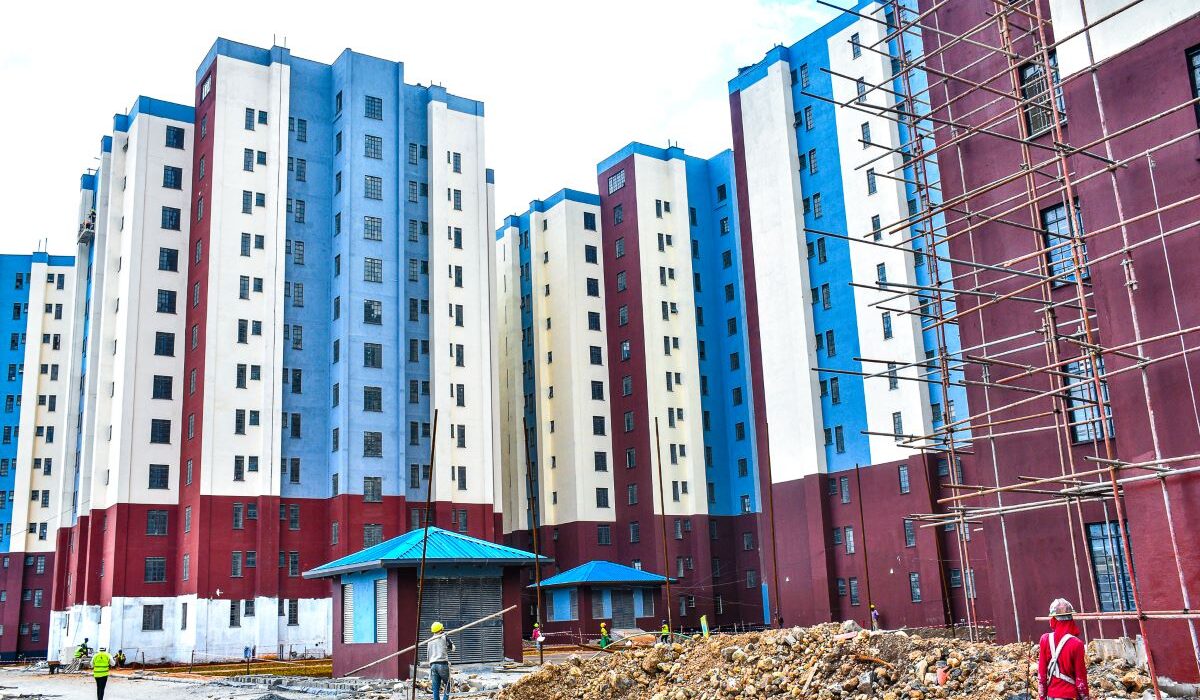
Registrations on the government’s Boma Yangu housing platform have surpassed one million, signalling growing public uptake of the Affordable Housing Programme as construction accelerates across the country.
The number of Kenyans registered on the government’s Boma Yangu housing platform has crossed the one-million mark, highlighting rising demand for units under the Affordable Housing Programme (AHP) as construction activity expands nationwide.
Data from the Affordable Housing Board shows that the milestone reflects increasing confidence among Kenyans in the government-backed housing initiative, which targets low-, middle- and higher-income earners through a mix of social, affordable and market-rate housing developments.
The Boma Yangu platform, accessed through bomayangu.go.ke, serves as the official portal through which prospective homeowners register, select housing units and make savings toward eventual ownership.
Growing appeal of affordable housing projects
According to the Affordable Housing Board, the projects have attracted strong interest due to their location within urban areas and the integration of essential infrastructure and public services.
Most developments are situated close to employment centres and are supported by roads, electricity and water connections, as well as social amenities such as schools, healthcare facilities, markets and shopping areas.
Housing Principal Secretary Charles Hinga said the one-million-user milestone reflects a shift in public perception toward the Affordable Housing Programme.
“One million Kenyans committing to own housing units is not a small feat. Kenyans have outgrown pessimism about AHP and are now saving money for their preferred unit through the government-owned portal, Boma Yangu,” Mr Hinga said.
The growing number of registrants suggests increasing acceptance of the programme as a viable pathway to home ownership, particularly for households previously priced out of the formal housing market.
Mukuru project cited as delivery benchmark
Mr Hinga pointed to the Mukuru Affordable Housing Project as evidence of accelerated delivery under the programme, contrasting it with earlier public housing efforts that progressed more slowly.
“This government is setting a historic precedent in housing delivery. While it took 15 years to build 5,000 units in Buruburu, the Mukuru AHP delivered 1,078 units in its first year and successfully handed over 4,500 completed units to new homeowners on 18th December,” he said.
The Mukuru development includes not only residential units but also supporting social infrastructure, underscoring the government’s shift toward integrated urban housing projects.
“The estate features a shopping complex, a Level 4 hospital, and an education complex comprising pre-primary, primary, junior, and senior secondary schools,” Mr Hinga said.
The project has been positioned as a model for future affordable housing developments in major urban centres, particularly in informal settlement upgrading and regeneration.
Housing options across income groups
The Affordable Housing Programme is structured to cater to a wide range of income levels, with differentiated housing products aimed at improving inclusivity.
According to the Housing State Department, social housing units target very low-income households earning up to KSh 20,000 per month. Affordable housing units are designed for low- to middle-income earners with monthly incomes ranging between KSh 20,000 and KSh 149,000.
Market-rate housing is also included within the programme to accommodate higher-income earners, enabling cross-subsidisation and supporting the financial sustainability of large-scale developments.
This tiered approach is intended to promote mixed-income communities while addressing Kenya’s long-standing housing deficit, which is estimated at more than two million units, with an annual shortfall of about 200,000 units.
Construction activity spreads across counties
Construction under the Affordable Housing Programme has expanded significantly, with projects now underway in 47 counties.
Data from the Affordable Housing Board shows that more than 262,913 housing units are currently under construction nationwide. The scale of activity has positioned the housing programme as a major driver of employment in the construction sector and related industries.
An estimated 428,000 Kenyans are directly employed full-time on Affordable Housing Programme construction sites, working across trades such as masonry, plumbing, electrical installation and site supervision.
In addition, about one million workers are engaged full-time in supplying raw materials, fittings, accessories and services to the construction sites, including cement, steel, doors, windows, tiles, transport and professional services.
The employment impact has strengthened the programme’s role as a stimulus for economic activity, particularly in counties where construction projects are among the largest ongoing public investments.
Economic and market implications
The rapid uptake of Boma Yangu registrations and the scale of construction point to growing demand for formal housing and increased participation by households in structured home ownership schemes.
For the construction sector, the programme has provided steady demand at a time when private real estate development has faced headwinds from higher financing costs and slower property sales.
The concentration of projects within urban and peri-urban areas has also supported demand for infrastructure development, utilities and social services, with spillover effects for local economies.
From a fiscal and policy perspective, the growth of the Affordable Housing Programme places increased focus on project delivery timelines, financing structures and long-term affordability for beneficiaries.
The one-million-registrant milestone is likely to intensify scrutiny of allocation processes, unit pricing and the pace at which completed houses are handed over to homeowners, as demand continues to outstrip supply in many locations.
Outlook
With registrations continuing to rise and construction activity expanding across counties, the Affordable Housing Programme is set to remain a central pillar of the government’s housing and urban development agenda.
The challenge ahead will be sustaining delivery momentum, ensuring quality standards, and maintaining affordability as costs of land, materials and financing evolve.
For now, crossing the one-million mark on the Boma Yangu platform signals a significant shift in public engagement with government-backed housing initiatives and underscores the scale of unmet housing demand in Kenya’s cities.