


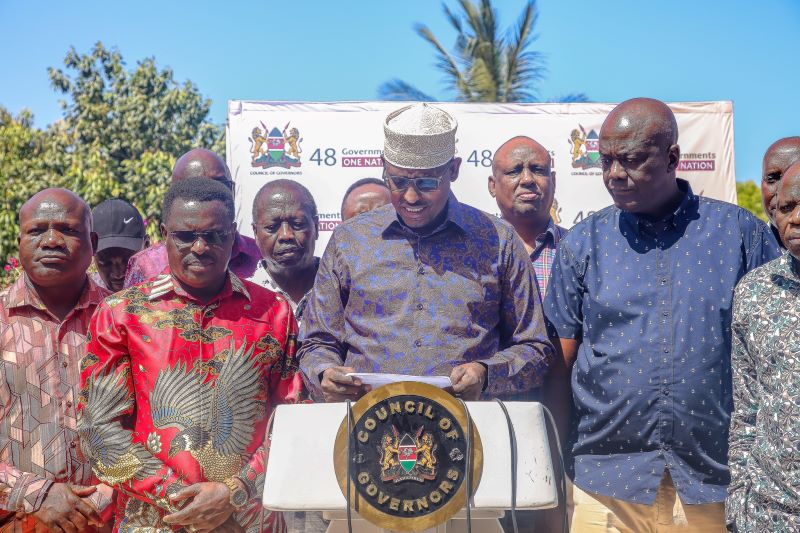
The Council of Governors has suspended all appearances before the Senate’s County Public Accounts and Investment Committee, citing alleged extortion, harassment and politicisation of oversight, pending talks with Senate leadership.
Kenya’s governors have suspended all appearances before the Senate’s County Public Accounts and Investment Committee (CPAIC), escalating a standoff between county executives and the upper House over allegations of extortion, harassment and abuse of oversight powers.
The unanimous decision was reached during a two-day Council of Governors (CoG) retreat held in Kilifi, attended by more than 30 governors, where they resolved that no governor would appear before the committee until a “candid and structured” meeting is held with Senate leadership to address the claims.
The retreat was held under the theme Re-positioning the Council for Effective Service Delivery in Light of the Political Environment, with governors insisting that while they fully support accountability and oversight, the conduct of CPAIC has undermined both principles.
Claims of extortion and intimidation
CoG chair and Wajir Governor Ahmed Abdullahi said governors had reached a breaking point, accusing the committee of turning oversight hearings into what he described as a “circus” designed to humiliate county leaders rather than ensure prudent use of public funds.
“The committee has become a theatre for public humiliation of governors,” Abdullahi said. “We are not running away from accountability, but harassment and extortion must come to an end.”
Governors at the retreat claimed that some members of the Senate committee had become notorious for soliciting bribes in exchange for favourable treatment during hearings or the softening of audit queries. While they declined to publicly name the senators involved during a press briefing, they said they were ready to present evidence, including identities, in an open meeting with Senate leadership.
The governors singled out four senators whom they allege are central to the extortion claims, saying the issue has persisted despite repeated complaints raised informally with parliamentary leadership.
Concerns over politicisation of oversight
The governors also accused some senators of politicising the CPAIC hearings by turning them into media spectacles. Abdullahi said some committee members had installed cameras in the hearing rooms to live-stream proceedings, arguing that this was intended to push political narratives rather than promote transparency.
According to the governors, the public nature of the sessions, combined with what they termed selective questioning and grandstanding, has damaged the credibility of the oversight process and discouraged honest engagement.
They further alleged that county officials and technical staff have been intimidated during hearings, with questioning sometimes veering away from audit findings into political attacks.
Defence of auditors and accountability process
In a significant intervention, the governors also came to the defence of auditors, claiming they had come under pressure from senators to implicate governors even where audit evidence did not support such conclusions.
The CoG said auditors who failed to align with certain narratives were subjected to criticism or hostility during hearings, undermining the independence of the audit process.
Governors demanded that Senate leadership institute a thorough investigation into the conduct of CPAIC members and consider reconstituting the committee to restore public confidence in parliamentary oversight.
Conditional engagement with Parliament
While suspending appearances before CPAIC, the governors clarified that they were not boycotting Senate oversight entirely. They said they would continue engaging with other Senate committees, including the County Public Investments Committee (CPIC), but called for reforms in how oversight sessions are conducted.
On CPIC appearances, governors said they should be summoned once per audit cycle, rather than being called repeatedly for multiple sessions on the same issues, which they argued disrupts county operations and service delivery.
“We are accountable, but accountability must be structured, fair and professional,” one governor said during the retreat.
Call for intervention from Senate leadership and Executive
The Council of Governors has formally demanded an urgent meeting with the Speaker of the Senate and Senate leadership to resolve the standoff and agree on a framework for respectful and effective oversight.
The governors also said they want President William Ruto to raise the matter with the Senate Speaker, citing the broader implications for devolution and intergovernmental relations.
Abdullahi disclosed that the issue had previously been discussed with President Ruto and former prime minister Raila Odinga during the 2025 Devolution Conference held in Homa Bay, where concerns were raised about the conduct of some senators.
“We spoke at length on this matter, and it was clear that what is happening is wrong,” Abdullahi said, adding that the situation risks undermining public trust in both county governments and Parliament.
Implications for devolution and public finance oversight
The standoff highlights growing tensions between county governments and the Senate, which is constitutionally mandated to protect the interests of counties and oversee their use of public funds.
Any prolonged suspension of CPAIC hearings could delay the consideration of audit reports, affecting the release of funds, approval of county budgets and overall fiscal accountability at the devolved level.
Governors warned that unless the issue is addressed urgently, the oversight process risks losing legitimacy and becoming a tool for political pressure rather than a safeguard for public resources.
For now, appearances before CPAIC remain suspended, with the Council of Governors insisting that meaningful engagement with Senate leadership is the only path to restoring trust and normalising accountability processes.