


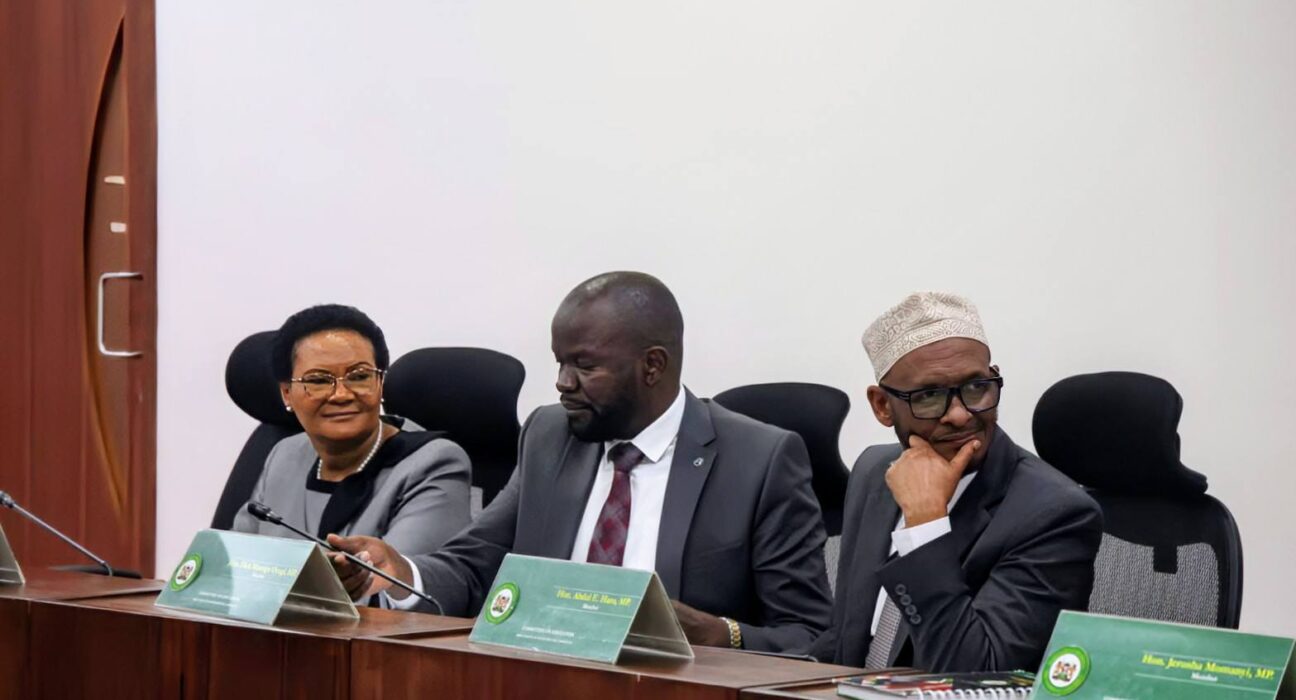
Members of the National Assembly Education Committee have raised fresh concerns over the growing financial distress facing Kenya’s public universities, warning that a KSh100 billion funding gap, delayed disbursements, and structural inefficiencies risk undermining higher education reforms anchored on the student-centred funding model.
Parliament Raises Alarm Over Mounting University Debts
Kenya’s public university financing crisis has returned to the parliamentary spotlight after the National Assembly Committee on Education questioned the continued accumulation of pending bills despite increased government allocations and the rollout of a needs-based student funding framework.
During a committee session chaired by Julius Melly, lawmakers engaged senior Ministry of Education officials over persistent liquidity constraints, salary arrears, pension liabilities, and the sustainability of higher education funding structures.
The meeting brought together officials led by Principal Secretary for Higher Education and Research Beatrice Inyangala, alongside Geoffrey Monari of the Higher Education Loans Board and Benedict Mutua of Technical University of Kenya.
Lawmakers said rising pending bills and operational deficits raise questions about whether ongoing reforms are adequately addressing systemic financial vulnerabilities across public institutions.
KSh100 Billion Financing Gap Underscores Structural Challenges
Appearing before the committee, Dr Inyangala disclosed that the Ministry is currently managing a funding deficit estimated at KSh100 billion across higher education institutions, even as government continues implementing a student-centred funding framework introduced by William Ruto.
According to the Principal Secretary, the financing shortfall reflects multiple pressures, including increased enrolment, cost-intensive academic programmes, infrastructure needs, and constrained fiscal space.
To mitigate the gap, the Ministry is pursuing a multi-pronged strategy focused on asset-based securitization, improved institutional financial management, and stronger loan recovery mechanisms.
Monthly loan recoveries have already improved from approximately KSh500 million to KSh650 million, she noted, although high youth unemployment remains a significant barrier to full repayment compliance.
The funding deficit highlights the broader fiscal balancing act facing government as it seeks to expand access to higher education while maintaining financial sustainability within public institutions.
Student-Centred Funding Model Faces Implementation Questions
Central to the committee’s deliberations was the performance of Kenya’s student-centred funding model, which allocates support based on household income, programme costs, and institutional efficiency indicators.
The model aims to enhance equity by ensuring students from vulnerable households receive higher levels of state support, while those from higher-income backgrounds contribute a larger share toward tuition.
Under the framework, annual student contributions can range from as low as KSh5,800 for the most vulnerable learners to approximately KSh150,000 for students assessed as financially capable.
However, lawmakers questioned whether funding flows under the model are reaching institutions predictably and at sufficient levels to sustain operations.
Despite increased allocations to student financing and institutional grants, universities continue reporting cash flow challenges, suggesting implementation gaps between policy design and fiscal execution.
Insolvency Risks Emerge Across Public Universities
One of the most concerning revelations during the session was that about eleven public universities are technically insolvent, reflecting prolonged financial imbalances between revenue inflows and expenditure obligations.
Dr Inyangala singled out Moi University and the Technical University of Kenya as institutions facing particularly severe financial distress.
The disclosure underscores the depth of structural weaknesses affecting university finances, including declining internally generated revenue, staff cost pressures, pension obligations, and capital expenditure backlogs.
The insolvency warning also raises broader questions about institutional restructuring, consolidation, or governance reforms that may be required to restore financial stability across the sector.
Institutions Detail Salary, Pension and Operational Pressures
University leaders appearing before the committee provided detailed accounts of operational constraints shaping their financial outlook.
Acting Vice-Chancellor Isaac Kiplagat told lawmakers that Moi University received approximately KSh1.5 billion during the previous financial year, largely directed toward staff salary payments and arrears settlement.
Nevertheless, the institution continues to carry a pension liability estimated at KSh4.5 billion, prompting plans to liquidate selected assets in partnership with the university pension fund to address outstanding obligations.
At the Technical University of Kenya, Vice-Chancellor Prof Mutua described a prolonged salary crisis dating back more than a decade.
The institution reportedly pays only net salaries due to funding limitations, with a monthly wage bill of roughly KSh102 million against Treasury disbursements of less than KSh60 million.
Additionally, a staff-to-student ratio approaching 1:1 was cited as financially unsustainable, highlighting the need for staffing rationalization and enrolment optimization.
HELB Disbursements and Cash Flow Synchronization
The role of student loan disbursements in stabilizing university finances also emerged as a key discussion point.
HELB CEO Geoffrey Monari urged the committee to support timely release of funds, emphasizing that university revenue streams under the new funding architecture are closely tied to student financing flows.
Delayed loan disbursements, he argued, can disrupt institutional cash flow cycles, affecting salary payments, procurement processes, and service delivery.
The observation reinforces the interconnected nature of Kenya’s higher education financing ecosystem, where student support mechanisms directly influence institutional solvency.
Committee Signals Possible Policy and Budget Recommendations
Closing the session, Chairperson Melly assured stakeholders that the committee would formulate recommendations aimed at improving predictability, adequacy, and transparency of higher education financing.
Potential interventions could include adjustments to budget allocations, strengthening oversight of funding model implementation, accelerating disbursement timelines, and supporting institutional financial restructuring.
The committee’s review comes at a critical time as government continues refining reforms intended to balance expanded access with fiscal sustainability across the education sector.
For universities, the outcome of parliamentary deliberations may shape funding stability in the medium term, while also informing broader policy debates around governance, efficiency, and diversification of revenue sources.
Outlook for Kenya’s Higher Education Financing Reform
The parliamentary engagement highlights the complex transition underway within Kenya’s higher education financing landscape.
While the student-centred funding model represents a significant policy shift toward equity and efficiency, its success will depend heavily on fiscal discipline, administrative coordination, and sustained economic recovery to support graduate employment and loan repayment.
With insolvency risks emerging and institutional debts continuing to mount, policymakers face mounting pressure to align reform ambitions with realistic financing pathways capable of safeguarding academic quality and institutional resilience.
As the National Assembly committee prepares its recommendations, the future trajectory of Kenya’s public universities will increasingly hinge on whether financing reforms can translate into tangible operational stability.