


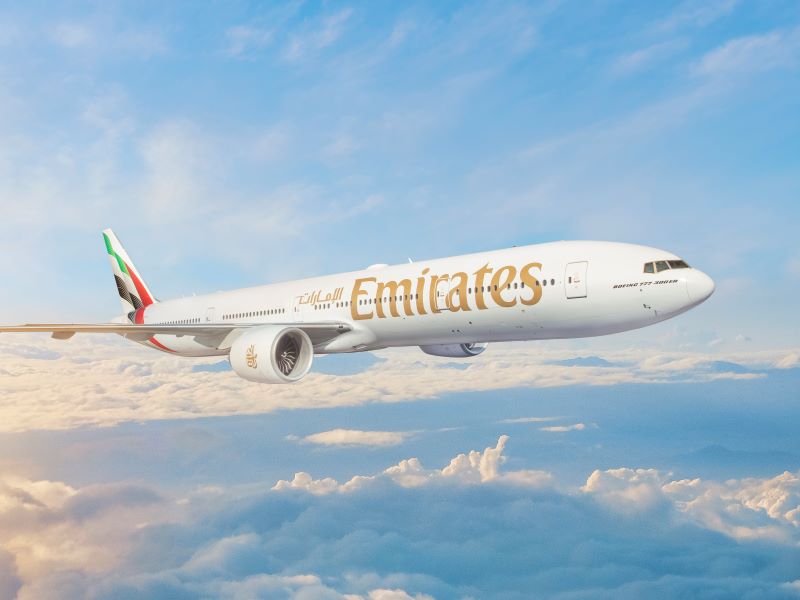
Emirates has introduced a split-payment capability for customers in Kenya through a partnership with African payments technology firm Cellulant, marking a strategic move to align global airline booking systems with the continent’s mobile-first payment landscape.
The functionality, powered by Cellulant’s Tingg payment gateway, allows customers booking flights on the airline’s website to combine multiple payment methods including mobile money, mobile banking transfers and local debit or credit cards within a single transaction.
Under the system, travellers can initiate a booking with an initial payment and complete up to four additional instalments within a 24-hour window, enabling completion of purchases while remaining within mobile wallet transaction thresholds.
The feature has debuted in Kenya and is expected to expand into additional African markets in the coming months, reflecting the region’s importance in the airline’s digital commerce strategy.
Addressing transaction limit barriers in mobile money ecosystems
Mobile money has become the dominant payment channel across much of Africa, including Kenya, where digital wallets underpin everyday consumer transactions. However, transaction ceilings imposed by providers have historically constrained the ability to complete high-value purchases such as international airline tickets.
Industry players say this limitation has resulted in incomplete bookings and reduced conversion rates for travel merchants operating in mobile-first markets.
Cellulant executives said the split-payment functionality directly targets this friction point by enabling travellers to distribute payments across channels and instalments without breaching daily or per-transaction limits.
“With hundreds of millions of Africans relying on mobile money as their preferred way to pay, extending this convenience to global travel payments is essential,” said Michael Muriuki, Chief Product and Technology Officer at Cellulant.
“Through Tingg, we are enabling Emirates customers to complete high-value transactions seamlessly, without transaction limits becoming a barrier to access,” he added.
Kenya positioned as strategic test market
Airline representatives indicated that Kenya’s mature mobile money ecosystem and strong outbound travel demand made it a natural launch market for the solution.
Christophe Leloup, Emirates’ Country Manager for Kenya, described the country as one of the airline’s most dynamic markets globally, citing sustained travel demand and digital adoption.
“By introducing split payments through Tingg by Cellulant, we unlock greater flexibility and convenience, while enabling more customers to access our product and services,” Leloup said.
Kenya’s advanced mobile payments infrastructure, led by services such as M-Pesa, has created an environment where digital commerce innovation can be deployed rapidly across consumer-facing sectors including travel, e-commerce and financial services.
Integration with existing financing and payment channels
The split-payment feature complements existing payment options offered by Emirates in Kenya, which include mobile app payments, bank transfers and card transactions processed through Cellulant’s network.
Across Africa, the partnership between the airline and the fintech firm spans 14 markets, including South Africa, Ghana and Zimbabwe, where alternative payment methods have been integrated to support local booking behaviour.
Aviation and payments industry observers note that such integrations are increasingly essential for international airlines seeking to capture growth in emerging markets where traditional card penetration remains relatively low compared to mobile wallet usage.
The introduction of instalment-style payments also reflects broader travel industry experimentation with flexible payment models, including buy-now-pay-later and staggered payment structures aimed at improving booking affordability.
Capacity expansion reinforces demand outlook
The payments innovation coincides with network expansion by Emirates on the Kenya–United Arab Emirates corridor, a route that has experienced sustained passenger demand.
The airline is set to introduce a third daily flight between Nairobi and Dubai from March 1, 2026, increasing available seat capacity on a route widely used for business travel, tourism, diaspora movement and onward global connections.
Recent operations of the airline’s existing double-daily flights have recorded strong seat occupancy levels, underscoring resilient travel demand despite broader cost-of-living pressures affecting discretionary spending in some markets.
Analysts say aligning payment flexibility with capacity growth could help airlines maintain load factors while expanding access to price-sensitive customer segments.
Implications for African travel and fintech ecosystems
The deployment of split payments in airline booking channels illustrates the convergence of aviation and fintech sectors in addressing structural barriers to cross-border commerce.
For airlines, enabling locally relevant payment methods can improve booking completion rates, reduce cart abandonment and broaden customer reach.
For fintech providers, integration with global travel merchants expands transaction volumes and demonstrates the scalability of African payment infrastructure in supporting high-value cross-border transactions.
Kenya’s role as an early deployment market may also provide a reference model for similar implementations across other mobile money-dominant economies.
Industry stakeholders note that as travel demand rebounds globally and digital payments continue to evolve, partnerships between airlines and payment platforms are likely to deepen, particularly in regions where payment fragmentation has historically limited e-commerce growth.
Outlook for consumer adoption
Consumer uptake of the split-payment option will depend on awareness, user experience and perceived value relative to existing payment methods.
However, the combination of payment flexibility, mobile wallet familiarity and instalment capability positions the feature to resonate with Kenya’s digitally active traveller base.
As Emirates scales the functionality across additional African markets, the initiative could influence competitive dynamics among airlines operating in the region, potentially prompting similar payment innovations aimed at enhancing customer acquisition and retention.
For Kenyan travellers, the launch signals an incremental shift toward more adaptable booking experiences that reflect the realities of local payment behaviour while maintaining access to global travel networks.