


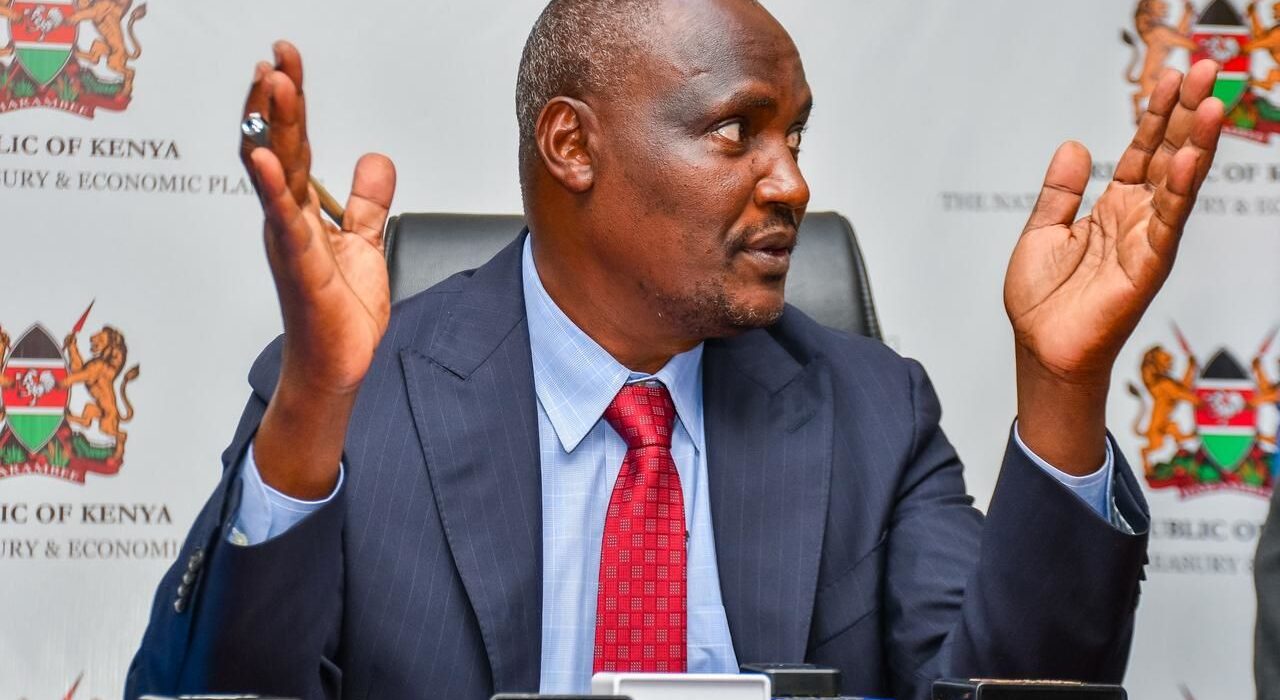
The Cabinet Secretary for the National Treasury, Hon. John Mbadi, has announced firm measures to halt the continued accumulation of pending bills across Ministries, Departments and Agencies (MDAs), even as the government embarks on a phased plan to clear the existing backlog.
Appearing before the National Assembly Budget and Appropriations Committee to present the 2026 Budget Policy Statement (BPS), Mbadi acknowledged that unpaid bills have accumulated over several years, placing strain on suppliers, contractors and service delivery across government.
Structured Approach To Clearing Arrears
Responding to concerns raised by Committee Chairperson Hon. Samuel Atandi (Alego Usonga) over the rising stock of pending bills, Mbadi conceded that the challenge is long-standing and cannot be resolved overnight.
“The pending bills have accumulated over the years. This is not something we are going to sort out today because resources are limited and we cannot stop the country from moving while we are still settling pending bills,” Mbadi told the committee.
He said the Treasury’s immediate focus is to prevent the creation of new arrears while gradually clearing outstanding obligations in a controlled and orderly manner.
“What we are doing first is to stop the accumulation of further pending bills. But those that have accumulated over the years, we will have to pay them, but in a standard manner so that they also don’t disrupt services,” he added.
Pending bills have been a persistent concern in Kenya’s public finance management system, with contractors and suppliers frequently citing delayed payments as a major risk to business continuity, particularly for small and medium-sized enterprises that rely on government contracts.
Push For Treasury Single Account
In a supplementary question, Hon. Mathias Robi (Kuria West) questioned the criteria used in settling arrears, arguing that newer contractors appear to be paid ahead of those whose invoices have remained unsettled for years.
“The problem we are facing in this country is that someone is given a contract today, and they will be paid, leaving people who were contracted like seven years ago. Why can’t you solve those earlier pending bills first?” Robi asked.
Mbadi acknowledged weaknesses in the existing payment processes, pointing to what he described as “cherry picking of invoices” by institutions once funds are disbursed.
“I think there has been cherry picking of invoices. That’s why I would ask this committee to support the Treasury Single Account because you will be requesting payment based on the age of the invoice, and once you request, you will just pay for what you requested for, as opposed to previously, when most institutions were asking for payment and once they get the money, they pay other invoices,” he said.
The proposed Treasury Single Account system is intended to centralise government cash management, enhance transparency and ensure that payments are processed systematically based on the age of invoices, thereby reducing discretion at the institutional level.
If fully implemented, the reform could reshape public sector cash flow management and improve predictability for businesses supplying goods and services to government entities.
2026/27 Revenue Projections
On the broader fiscal framework, Mbadi informed the committee that total revenue, inclusive of Appropriation in Aid (AIA), is projected at KSh 3.5337 trillion in the 2026/27 financial year, equivalent to 16.9 percent of Gross Domestic Product (GDP).
The projections comprise:
- Ordinary revenue of KSh 2.9019 trillion (13.9 percent of GDP); and
- Appropriation in Aid of KSh 631.8 billion.
The revenue targets signal continued efforts by the Treasury to expand the tax base and strengthen revenue administration amid fiscal consolidation pressures.
Kenya has faced mounting debt servicing obligations in recent years, prompting the government to prioritise domestic revenue mobilisation while managing borrowing levels.
Expenditure And Deficit Outlook
Total expenditure and net lending for FY 2026/27 are projected at KSh 4.7039 trillion, representing 22.5 percent of GDP.
The expenditure breakdown includes:
- Recurrent spending of KSh 3.4569 trillion (16.5 percent of GDP);
- Development expenditure of KSh 749.5 billion (3.6 percent of GDP);
- Transfers to County Governments amounting to KSh 495.5 billion; and
- An allocation of KSh 2.0 billion to the Contingency Fund.
The fiscal deficit, including grants, is expected to decline to KSh 1.1158 trillion (5.3 percent of GDP) in FY 2026/27, compared to a projected deficit of KSh 1.1407 trillion (6.0 percent of GDP) in FY 2025/26.
“The FY 2026/27 fiscal deficit will be financed through net external borrowing amounting to KSh 225.5 billion and net domestic financing of KSh 890.4 billion,” Mbadi told lawmakers.
The projected narrowing of the deficit reflects the government’s commitment to fiscal consolidation under its medium-term fiscal framework, aimed at stabilising debt levels and maintaining macroeconomic stability.
Implications For Business And Markets
For the private sector, the Treasury’s commitment to halt new pending bills could ease liquidity pressures faced by contractors and suppliers, particularly in construction, healthcare and infrastructure sectors where delayed payments have historically constrained operations.
The planned Treasury Single Account system may also enhance confidence among investors and development partners by strengthening public financial management controls and reducing opacity in payment processes.
However, the scale of the existing backlog means that businesses awaiting payment may continue to face delays as the government balances arrears clearance with ongoing service delivery and development spending.
The Budget and Appropriations Committee is currently compiling its report on the Budget Policy Statement, incorporating submissions from stakeholders and Departmental Committee Chairpersons. The report is expected to be tabled in the National Assembly for debate later this week, setting the stage for the next phase of Kenya’s budget-making process.