


Listed agribusiness firm Kakuzi Plc has reported a return to profitability, posting a KSh387.5 million net profit for the year ended 2025, marking a significant turnaround from a KSh131.6 million loss recorded in 2024.
The improved performance comes amid a recovery in key product segments, operational efficiencies, and ongoing diversification efforts aimed at cushioning the business against global market volatility.
The company’s board has proposed a first and final dividend of KSh16 per share, double the payout issued in the previous year, signalling renewed confidence in earnings stability and cash flow generation.
Revenue Growth and Profit Recovery
Kakuzi recorded total revenues of KSh5.4 billion, translating into a pre-tax profit of KSh568 million, compared to a pre-tax loss of KSh167 million in 2024.
The rebound reflects a combination of stronger commodity performance, improved operational execution, and mitigation of challenges that weighed on the business in the prior year.
Chairman Nicholas Ng’ang’a said the company had addressed some of the key issues that contributed to the earlier losses, although external pressures remain.
“While certain circumstances that led to the loss in 2024 have been mitigated, geopolitical tensions continue to negatively impact the firm’s flagship avocado operations,” he said.
Avocado Segment Leads Earnings
The avocado business remained the company’s primary profit driver, with segment earnings rising 96 percent to KSh709 million, up from KSh361 million in 2024.
Production volumes increased by 23 percent, supported by expanded acreage and improved yields.
However, export operations faced headwinds linked to global logistics disruptions, particularly along the Red Sea shipping route, which continued to affect fruit quality and pricing despite partial reopening.
European markets, which account for a significant share of exports, recorded lower prices for the Hass avocado crop due to increased supply from competing producers such as Peru, South Africa, and Colombia.
Kakuzi exported 525 containers during the year, up from 446 containers in 2024, at an average price of €7.13 per carton.
Pest Pressure and Market Risks
The company flagged increasing pest and disease pressure as a growing risk to avocado production, driven by the rapid expansion of orchards across Kenya.
Managing Director Chris Flowers noted that the company is working with industry stakeholders to develop proactive solutions.
“Pest pressure continues to intensify nationally as the area under avocado orchards increases. We continue to work with relevant partners to develop new techniques to manage these emerging issues,” he said.
To reduce dependence on European markets, Kakuzi is exploring alternative export destinations, including China and India, although these markets are not yet large enough to offset European demand.
Macadamia and Blueberry Segments Rebound
The macadamia business posted a strong recovery, with profits rising to KSh365 million from KSh69 million in the previous year.
The improvement was driven by recovering global demand and better pricing, following a period of subdued market conditions.
Meanwhile, the blueberry segment returned to profitability, recording a KSh5 million profit compared to a KSh19 million loss in 2024.
Production volumes increased to 90 tonnes, up from 53 tonnes, signalling early success in the company’s diversification into high-value superfoods.
Despite high establishment costs, management indicated that blueberries are expected to play a growing role in the company’s long-term revenue mix.
Diversification and Domestic Market Growth
Kakuzi has intensified its diversification strategy, expanding beyond traditional export markets and investing in value-added products.
The company reported growing traction in the domestic market, with local sales exceeding KSh50 million, supported by retail offerings through its farm-based outlets.
Products driving domestic revenue include:
- Ready-to-eat macadamia nuts
- Cold-pressed macadamia oil
- Fresh avocados and blueberries
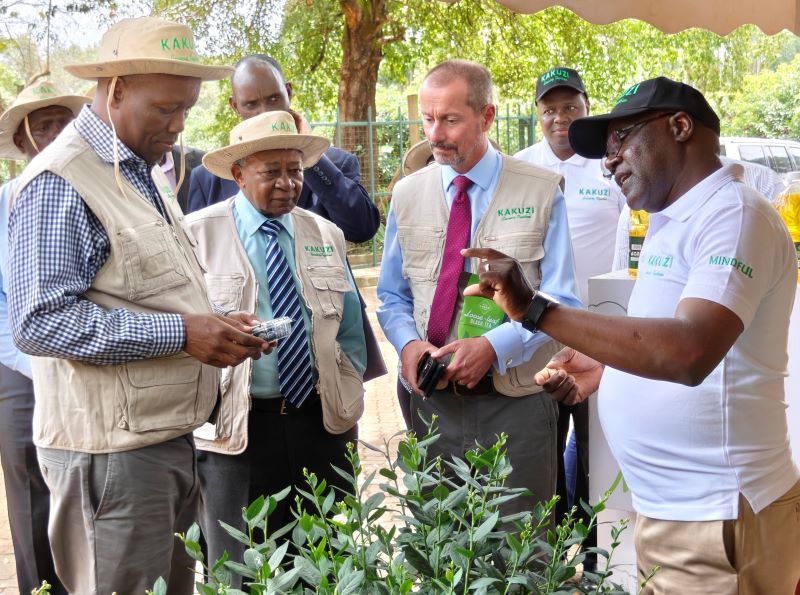
- Newly introduced loose-leaf tea products
This shift marks a strategic pivot from a historically export-focused model towards a more balanced revenue mix.
Investment in Sustainability
As part of its long-term strategy, Kakuzi has also invested in sustainability initiatives aimed at enhancing resilience to climate variability.
The company expanded its irrigation capacity by adding 1 million cubic metres of rainwater storage, bringing total storage capacity to 13 million cubic metres.
This investment strengthens water security and supports year-round agricultural operations, reducing reliance on external water sources.
“These sustainability and business development initiatives demonstrate our commitment to integrating sustainable agricultural practices into our operations,” said Mr Flowers.
Outlook
Kakuzi’s management expressed cautious optimism about future performance, citing ongoing risks related to global logistics, market pricing, and climate conditions.
However, the company expects its diversification strategy, improved governance, and operational efficiencies to support continued growth.
The combination of expanding product lines, entry into new markets, and increased domestic sales is expected to enhance resilience and reduce exposure to external shocks.
As Kenya’s agribusiness sector continues to evolve, Kakuzi’s performance highlights both the opportunities and challenges facing export-oriented agricultural firms navigating global supply chains and shifting market dynamics.