


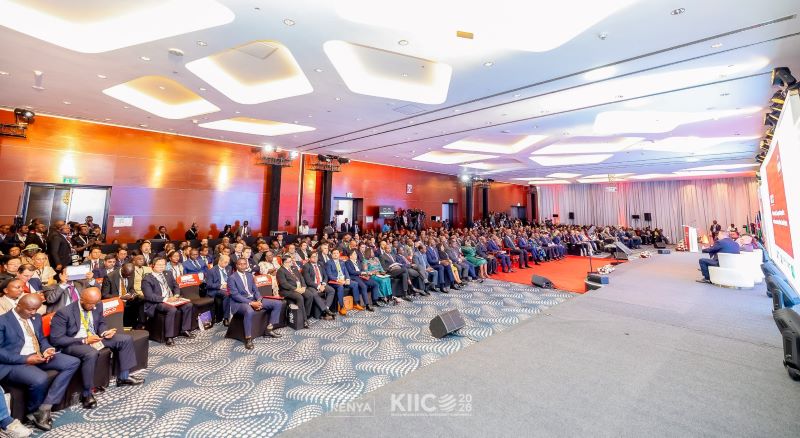
Kenya International Investment Conference 2026 opened with a strong showing of investor confidence, as the government and private sector unveiled 20 investment deals worth a combined $2.9 billion, equivalent to about KSh377 billion, alongside commitments to create more than 63,000 jobs across key sectors of the economy.
The deals span agriculture, manufacturing, real estate, mining, healthcare, energy, and business process outsourcing, reflecting a broad-based push to attract capital into productive sectors aligned with Kenya’s industrialisation and job creation agenda.
At the top end of the investment pipeline are large-scale projects led by Mombasa Creekside Gardens at $380 million, Devki Group at $370 million, and Buru Rare Earth Elements at $350 million. These anchor investments underscore growing interest in real estate development, manufacturing expansion, and mineral exploration.
Agriculture Dominates Investment Flow
Agriculture emerged as the leading sector by value, attracting approximately $890 million in commitments. The sector’s prominence reflects its central role in Kenya’s economy, both as a source of employment and as a driver of exports and food security.
Among the largest agricultural investments is Tana Bliss Kenya Ltd, a joint India and Kenya venture committing $300 million and expected to create nearly 19,750 jobs in Tana River County. Sukari Industries and Tana River Sugar have also pledged $300 million and $285 million respectively, further consolidating the region’s position as a key sugar production hub.
Additional investments include Blue Skies Holding Ltd from the United Kingdom, which is set to inject $12 million into agro-processing operations, supporting value addition and export-oriented production.
The clustering of these projects in Tana River signals a deliberate effort to unlock underutilised agricultural potential in Kenya’s coastal and arid regions.
Real Estate and Urban Development Gains Momentum
The real estate sector accounted for about $630 million in announced deals, driven by growing demand for urban housing, mixed-use developments, and tourism-linked infrastructure.
Mombasa Creekside Gardens, a Kenya and UAE-backed project valued at $380 million, leads the segment with plans to create over 1,500 jobs in Mombasa. In Nairobi, the Belle Vue Arch project, also backed by Kenya and UAE investors, will inject $250 million into the capital’s property market and generate more than 2,000 jobs.
These developments reflect sustained investor interest in Kenya’s urban growth corridors, particularly in Nairobi and Mombasa, where population growth and rising middle-class demand continue to drive real estate expansion.
Manufacturing Investments Target Industrial Growth
Manufacturing attracted approximately $600 million in commitments, reinforcing the government’s push to expand industrial output and reduce reliance on imports.
Devki Group’s $370 million investment in Kitui stands out as one of the largest industrial commitments at the conference, with an estimated 6,000 jobs expected to be created. The project is expected to deepen local production capacity and support value chains linked to construction and infrastructure.
Other manufacturing investments include Fullcare EPZ Ltd from China with a $100 million commitment in Kiambu, and Lucky DJX Kenya Co., also from China, investing $65 million in Machakos. Additional projects from Uganda, Singapore, and Kenyan firms highlight increasing regional and international participation in Kenya’s industrial sector.
Smaller-scale but job-intensive projects such as Line Plast Group in Kiambu are expected to generate up to 8,000 jobs, indicating a mix of capital-intensive and labour-intensive investments within the manufacturing pipeline.
Emerging Sectors Attract Strategic Capital
Beyond the traditional sectors, the conference also showcased growing investor interest in emerging areas such as mining, healthcare, energy, and business process outsourcing.
The Buru Rare Earth Elements project, backed by Australian interests, signals rising attention to Kenya’s mineral resources, particularly in critical minerals that are increasingly in demand globally for clean energy technologies.
In healthcare, multiple investments are set to expand medical infrastructure and services. These include projects backed by UAE and India-linked investors targeting Nairobi and Uasin Gishu, with a combined value exceeding $300 million.
The energy sector also featured in the deal pipeline, with Malindi Solar Ltd committing $71 million toward renewable energy development in Kilifi County. This aligns with Kenya’s broader transition toward clean energy and its ambition to maintain leadership in renewable power generation in Africa.
Meanwhile, ADEC Innovations from the United States announced a $10 million investment in business process outsourcing operations in Machakos, highlighting Kenya’s growing role as a regional hub for digital services and outsourced business functions.
Jobs and Regional Distribution
The 20 deals are expected to create more than 63,000 jobs across multiple counties, including Tana River, Mombasa, Nairobi, Kitui, Kiambu, Machakos, Bungoma, Kericho, Uasin Gishu, and Kilifi.
The geographic spread of investments reflects a deliberate strategy to decentralise economic activity and promote inclusive growth beyond the traditional urban centres.
Counties such as Machakos and Kiambu continue to attract manufacturing and logistics investments due to their proximity to Nairobi and established infrastructure, while regions like Tana River are emerging as new frontiers for large-scale agricultural projects.
Policy Implications and Investment Outlook
The scale and diversity of deals announced at KIICO 2026 point to sustained investor confidence in Kenya’s economic prospects, despite global uncertainties and domestic fiscal pressures.
The conference serves as a key platform for the government to position Kenya as a preferred investment destination in East Africa, leveraging its strategic location, relatively diversified economy, and improving business environment.
For policymakers, the focus will now shift to implementation, ensuring that announced projects move from commitments to execution. This includes addressing regulatory bottlenecks, improving infrastructure, and maintaining macroeconomic stability to support investor confidence.
The emphasis on sectors such as agriculture, manufacturing, and renewable energy aligns with Kenya’s long-term development priorities, including food security, industrialisation, and sustainable growth.
As the conference continues, attention will be on whether additional deals are announced and how quickly the existing commitments translate into tangible economic activity.